Hong Kong to give big cash handouts as economy reels from virus

Hong Kong to give big cash handouts as economy reels from virus

Hong Kong, Feb 26 (AFP) Hong Kong’s government on Wednesday said it will give a HK 10,000 ( 1,280) handout to seven million permanent residents in a bid to jump-start a recession-hit economy now compounded by the coronavirus outbreak.

Financial Secretary Paul Chan unveiled the cash gift in an annual budget, committing 120 billion to help alleviate the worst economic downtown the international financial hub has faced in a decade.

Hong Kong boasts significant fiscal reserves of more than HK 1 trillion built up over the boom years, a stockpile that the government is now tapping into.

The cash handout alone will cost HK 71 billion but officials hope consumers will plough much of the money back into local businesses.

“Making good use of fiscal reserves to support enterprises and relieve people’s hardship is certainly in line with our people’s expectations,” he said.

Hong Kong’s economy is reeling from the US-China trade war, months of pro-democracy protests last year and now the coronavirus: a triple whammy Chan described as “exceptionally austere”.

Other measures announced in the budget included profits and salary tax breaks as well as low interest loans for businesses struggling to pay staff wages.

The tourist, restaurant and retail sectors have been hit especially hard with bankruptcies soaring and traditionally low unemployment rising.

“Hong Kong’s economy is facing enormous challenges this year,” Chan said, predicting a range of 0.5 percent growth to a 1.5 percent contraction this year.

The recession is a major headache for the city’s unelected pro-Beijing leader Carrie Lam who currently boasts record low approval ratings after facing down huge democracy protests.

The massive rallies and regular clashes with police that became a weekly fixture last year were dying down before the outbreak began.

But the virus has comprehensively ended mass gatherings.

Yet public anger still simmers in a city where neither its leadership nor Beijing have addressed the issues fuelling years of rising resentment.

Neighbouring Macau often announces universal cash handouts to residents in its annual budget. Hong Kong has historically been more reticent.

The last handout for all residents was in 2011, three years after the global crash sparked the city’s last recession.

Last week Hong Kong’s government announced a HK 30 billion relief fund for those hit hardest by the virus outbreak, including cash handouts for businesses like restaurants and travel companies.

Chan said the city was set to record a record high deficit this year — its first in 15 years.

The last time Hong Kong ran a deficit was between 2001 and 2004. Chan said the reserves should see the city through the current crisis “In the medium term, the economic outlook of Hong Kong remains positive,” he said.

सरकार ने 6.5 लाख टन चीनी के निर्यात कोटा का नए सिरे से आवंटन किया

(भाषा) सरकार ने अधिकतम स्वीकार्य निर्यात कोटा (एमएईक्यू) योजना के तहत 2019-20 के मौजूदा विपणन वर्ष के लिए 6,50,000 टन चीनी कोटा का नए सिरे से आवंटन किया है। इस कोटा का इस्तेमाल नहीं हो पाया था। खाद्य मंत्रालय के एक वरिष्ठ अधिकारी ने सोमवार को यह जानकारी दी।

सरकार ने चालू साल के लिए कोटा के तहत 60 लाख टन चीनी निर्यात की मंजूरी दी थी। अधिशेष चीनी की स्थिति से निपटने को यह कदम उठाया गया था।
खाद्य मंत्रालय में संयुक्त सचिव सुबोध सिंह ने कहा कि कुछ मिलें इस साल अपने निर्यात कोटा को पूरा नहीं कर सकी हैं। वहीं कुछ मिलों ने 2,50,000 टन के निर्यात कोटा को छोड़ दिया है।
सिंह ने कहा, ‘‘हमने एक फॉर्मूले के आधार पर समूचे कोटा को समायोजित किया है। कुल 6,50,000 टन के निर्यात कोटा का नए सिरे से आवंटन किया गया है।’’
सिंह ने यहां एथेनॉल पर आयोजित एक कार्यक्रम के मौके पर संवाददाताओं से अलग से बातचीत में कहा कि ऊंची वैश्विक मांग से चालू विपणन वर्ष (अक्टूबर-सितंबर) के दौरान चीनी का कुल निर्यात 50 लाख टन पर पहुंच सकता है।
भारत ने 2018-19 के विपणन वर्ष में 50 लाख टन के अनिवार्य कोटा पर 38 लाख टन चीनी का निर्यात किया था।
अधिकारी ने कहा कि इस साल देश का कुल चीनी उत्पादन 2.7 करोड़ टन रह सकता है। इससे पिछले दो वर्ष के दौरान चीनी का उत्पादन 3.3 करोड़ टन रहा था। अभी तक मिलें 1.6 से 1.7 करोड़ टन चीनी का उत्पादन कर चुकी हैं।
इस साल पेट्रोल में एथेनॉल के मिश्रण के बारे में सिंह ने कहा कि हम पांच प्रतिशत यानी 1.9 अरब लीटर के स्तर को हासिल कर पाएंगे। हालांकि, इसके लिए नीति 10 प्रतिशत की है।
सिंह ने कहा, ‘‘इस साल इसे हासिल करना मुश्किल होगा क्योंकि महाराष्ट्र में गन्ने का उत्पादन काफी घट गया है। हालांकि, हम पांच प्रतिशत को हासिल कर पाएंगे।’’
देश में अभी एथेनॉल का उत्पादन 355 करोड़ लीटर है। हालांकि, पेट्रोलियम विपणन कंपनियों (ओएमसी) की जरूरत 511 करोड़ लीटर की है। दिल्ली, 24 फरवरी (भाषा) सरकार ने अधिकतम स्वीकार्य निर्यात कोटा (एमएईक्यू) योजना के तहत 2019-20 के मौजूदा विपणन वर्ष के लिए 6,50,000 टन चीनी कोटा का नए सिरे से आवंटन किया है। इस कोटा का इस्तेमाल नहीं हो पाया था। खाद्य मंत्रालय के एक वरिष्ठ अधिकारी ने सोमवार को यह जानकारी दी।
सरकार ने चालू साल के लिए कोटा के तहत 60 लाख टन चीनी निर्यात की मंजूरी दी थी। अधिशेष चीनी की स्थिति से निपटने को यह कदम उठाया गया था।
खाद्य मंत्रालय में संयुक्त सचिव सुबोध सिंह ने कहा कि कुछ मिलें इस साल अपने निर्यात कोटा को पूरा नहीं कर सकी हैं। वहीं कुछ मिलों ने 2,50,000 टन के निर्यात कोटा को छोड़ दिया है।
सिंह ने कहा, ‘‘हमने एक फॉर्मूले के आधार पर समूचे कोटा को समायोजित किया है। कुल 6,50,000 टन के निर्यात कोटा का नए सिरे से आवंटन किया गया है।’’
सिंह ने यहां एथेनॉल पर आयोजित एक कार्यक्रम के मौके पर संवाददाताओं से अलग से बातचीत में कहा कि ऊंची वैश्विक मांग से चालू विपणन वर्ष (अक्टूबर-सितंबर) के दौरान चीनी का कुल निर्यात 50 लाख टन पर पहुंच सकता है।
भारत ने 2018-19 के विपणन वर्ष में 50 लाख टन के अनिवार्य कोटा पर 38 लाख टन चीनी का निर्यात किया था।
अधिकारी ने कहा कि इस साल देश का कुल चीनी उत्पादन 2.7 करोड़ टन रह सकता है। इससे पिछले दो वर्ष के दौरान चीनी का उत्पादन 3.3 करोड़ टन रहा था। अभी तक मिलें 1.6 से 1.7 करोड़ टन चीनी का उत्पादन कर चुकी हैं।
इस साल पेट्रोल में एथेनॉल के मिश्रण के बारे में सिंह ने कहा कि हम पांच प्रतिशत यानी 1.9 अरब लीटर के स्तर को हासिल कर पाएंगे। हालांकि, इसके लिए नीति 10 प्रतिशत की है।
सिंह ने कहा, ‘‘इस साल इसे हासिल करना मुश्किल होगा क्योंकि महाराष्ट्र में गन्ने का उत्पादन काफी घट गया है। हालांकि, हम पांच प्रतिशत को हासिल कर पाएंगे।’’
देश में अभी एथेनॉल का उत्पादन 355 करोड़ लीटर है। हालांकि, पेट्रोलियम विपणन कंपनियों (ओएमसी) की जरूरत 511 करोड़ लीटर की है।

Financial Reporting by Finance Commission

Finance Commission Report

The report of the Fifteenth Finance Commission, along with an Action Taken Report, was tabled in Parliament.
The Commission, headed by N K Singh, had submitted its Report to the President in December 2019.
The government had accepted the recommendations of the Commission “in substantial measure a/c to FM.
The Finance Commission and its purpose

Article 280 of the Constitution requires that a Finance Commission be constituted to recommend the distribution of the net proceeds of taxes between the Centre and states, and among the states.
Much has changed since the First Commission was set up in November 1951 under the Chairmanship of K C Neogy, a former member of the Constituent Assembly and diwan of a princely state.
The President has appointed 14 more Commissions since then.

Why need Finance Commission?

The framers of the Constitution were seeking to address the vertical imbalance between the taxation powers and expenditure and responsibilities of the federal government and the states, and the horizontal imbalance, or inequality, between states that were at different stages of development.
Ensuring inclusiveness is, therefore, a key mandate of the Finance Commission.
That means assigning weights to things like population, the fiscal distance between the top ranked states and the others, etc.
It is not that the best-performing state will be allocated the highest share — even if delivery execution and governance are better — rather, the effort will be to narrow the development gap between states.
Constitution of the Finance Commission

The Finance Commission Rules, 1951, lay down the criteria for being members of the constitutional body.
Members:

those having special knowledge of finance and accounts of government with wide knowledge and experience in financial matters and in administration,
or with special knowledge of economics, and
those who have been qualified to be appointed as a judge of a High Court
Notable members

In the years following the reforms of the 1990s, Commissions have been headed by reputed economists and administrators — from A M Khusro, who headed the Eleventh Finance Commission, to Chakravarthi Rangarajan, Vijay Kelkar, and Y V Reddy, who were Chairmen of subsequent Commissions.
Senior politicians like K Brahmananda Reddy, Y B Chavan and N K P Salve had helmed earlier Commissions.
Before N K Singh, an economist and career administrator who subsequently joined politics, the last politician in this role was K C Pant, who then went on to be Deputy Chairman of the Planning Commission.
Changing role of the Finance Commission

What has changed dramatically since the 1950s, when the First Commission presented its recommendations on the transfer of resources between the Centre and the states, is the scale of distribution of tax proceeds.
From 10% of the total tax receipts of the Centre in 1950, it rose to a record 42% after the recommendations of the Fourteenth FC headed by Y V Reddy — a share that made previous awards look conservative, and sat well with the spirit of cooperative federalism.
The Fifteenth FC has recommended that this allocation be reduced by a percentage point to 41% in order to meet the security and special needs of the erstwhile state of Jammu and Kashmir.
The other significant change has been in the equation between the central and state governments as a result of the recommendations of the Twelfth FC which reshaped lending by the federal government to states.
The Fourteenth Commission recommended the creation of a Fiscal Council; the Thirteenth had set out detailed measures on implementing GST with a grand bargain for states.

भारत की अर्थव्यवस्था गंभीर सुस्ती के दौर में, तत्काल नीतिगत कदमों की जरूरत : आई एम एफ

  • भारत की अर्थव्यवस्था गंभीर सुस्ती के दौर में, तत्काल नीतिगत कदमों की जरूरत : आई एम एफ

वाशिंगटन, 24 दिसंबर (भाषा) भारतीय अर्थव्यवस्था इस समय गंभीर सुस्ती के दौर में है और सरकार को इसे उबारने के लिए तत्काल नीतिगत उपाय करने की जरूरत है। अंतरराष्ट्रीय मुद्राकोष (आईएमएफ) ने यह बात कही है।

सोमवार को जारी रिपोर्ट में आईएमएफ के निदेशकों ने लिखा है कि भारतीय अर्थव्यवस्था में हाल के वर्षों में जो जोरदार विस्तार हुआ है उससे लाखों लोगों को गरीबी से निकालने में मदद मिली।

हालांकि, 2019 की पहली छमाही में विभिन्न कारणों से भारतीय अर्थव्यवस्था की वृद्धि दर सुस्त पड़ी है।

आईएमएफ एशिया और प्रशांत विभाग में भारत के लिए मिशन प्रमुख रानिल सलगादो ने पीटीआई भाषा से साक्षात्कार में कहा, ‘‘भारत के साथ मुख्य मुद्दा अर्थव्यवस्था में सुस्ती का है। हमारा अब भी मानना है कि भारतीय अर्थव्यवस्था में सुस्ती संरचनात्मक नहीं, चक्रीय है। इसकी वजह वित्तीय क्षेत्र का संकट है। इसमें सुधार उतना तेज नहीं होगा जितना हमने पहले सोचा था। यह मुख्य मुद्दा है।’’

इस दौरान आईएमएफ ने भारत पर अपनी वार्षिक रिपोर्ट भी जारी की।

भारत के लिए परिदृश्य नीचे की ओर जाने का है। ऐसे में आईएमएफ के निदेशकों ने ठोस वृहद आर्थिक प्रबंधन पर जोर दिया है। रिपोर्ट में कहा गया है कि निदेशकों को लगता है कि मजबूत जनादेश वाली नयी सरकार के सामने यह सुधारों को आगे बढ़ाने का एक बेहतर अवसर है। इससे समावेशी और सतत वृद्धि को प्रोत्साहन मिलेगा।

सलगादो ने संवाददाताओं से कहा कि भारत इस समय गंभीर सुस्ती के दौर में है। चालू वित्त वर्ष की दूसरी तिमाही में सकल घरेलू उत्पाद (जीडीपी) की वृद्धि दर घटकर 4.5 प्रतिशत पर आ गई है जो इसका छह साल का निचला स्तर है। वृद्धि आंकड़ों से पता चलता है कि तिमाही के दौरान घरेलू मांग सिर्फ एक प्रतिशत बढ़ी है।

सलगादो ने कहा कि इसकी वजह गैर बैंकिंग वित्तीय कंपनियों (एनबीएफसी) के ऋण में कमी है। इसके अलावा व्यापक रूप से ऋण को लेकर परिस्थितियां सख्त हुई हैं। साथ ही आमदनी, विशेषरूप से ग्रामीण आय कम रही है। इससे निजी उपभोग प्रभावित हुआ है।

Rupee slips 4 paise to 71.78 against USD in early trade

  • Rupee slips 4 paise to 71.78 against USD in early trade

Mumbai, Dec 2 (PTI)

The Indian rupee opened on a cautious note and fell 4 paise to 71.78 against the US dollar in early trade on Monday as economic growth concerns and rising crude oil prices kept investors edgy.

Forex traders said investors traded cautiously after India’s Q2 GDP growth dipped to over 6-yr low of 4.5 per cent.

India’s GDP growth hit an over six-year low of 4.5 per cent in July-September 2019, dragged mainly by deceleration in manufacturing output and subdued farm sector activity, according to official data released on Friday.

At the interbank foreign exchange, the rupee opened weak at 71.78 against the US dollar, showing a decline of 4 paise over its previous closing.

The Indian rupee on Friday had closed at 71.74 against the US dollar.

The rupee, however, pared initial losses and was trading at 71.69 against the US dollar at 0935 hrs.

Traders noted that the strengthening of the American dollar vis-a-vis other currencies overseas and sustained foreign fund outflows weighed on the domestic currency.

However, positive opening in domestic equities supported the rupee and restricted the fall.

Domestic bourses opened on a positive note on Monday with benchmark indices Sensex trading 142.28 points up at 40,936.09 and Nifty higer by 28.10 points at 12,084.15.

Meanwhile, foreign institutional investors (FIIs) sold shares worth Rs 1,892.29 crore on Friday, according to provisional exchange data.

The dollar index, which gauges the greenback’s strength against a basket of six currencies, rose by 0.04 per cent to 98.31.

Crude oil benchmark, Brent Futures, rose 1.26 per cent to USD 61.26 per barrel.

The 10-year government bond yield was at 6.46 per cent in morning trade.

5 T इकोनॉमी की उम्मीदों के फ़साने!

भारत को 5 ट्रिलियन डॉलर की अर्थव्यवस्था बनने के लिए बहुत कुछ नया और तेज़ गति से करना पड़ेगा।एक ऐसा रोडमैप तैयार करना पड़ेगा जिस पर तेज़ गति से अर्थव्यवस्था के सभी क्षेत्रों को आगे की ओर बढ़ाया जा सके।भारत के नीति निर्माताओं को कुछ खास कामों को अंजाम देना पड़ेगा।”पॉलिसी को तत्काल प्रोजेक्ट में तब्दील करने की काबिलियत विकसित करनी पड़ेगी। हालांकि imf का आंकलन है कि भारत की अर्थव्यवस्था 4.7 ट्रिलियन की 2024 तक हो सकती है।इसी से उत्साहित हो कर भारत के नीति नियंता इतने बड़े सपने को जीने की कोशिश कर रहे हैं। वस्तुतः ये आँकलन इस आधार पर आया है कि us और china के ट्रेड वार की वजह से mncs भारत की तरफ ध्यान केंद्रित कर रही हैं।अगर हम वर्तमान समय की भारतीय अर्थव्यवस्था की गति और स्थिति की तरफ़ ध्यान दें तो बहुत उत्साहजनक माहौल नहीं है।

2011-12 के स्थाई मूल्यों के आधार पर GVA 1.8 ट्रिलियन बैठता है और GDP 2 ट्रिलियन डॉलर बैठती है।यदि जीडीपी को कर्रेंट मूल्यों पर आंकें तो GDP 2.5 ट्रिलियन डॉलर बैठता है। ये तस्वीरें थोड़ी निराश करती हैं। किंतु जब हम वर्ल्ड बैंक के भारतीय जीडीपी के अनुमानों को देखें तो यह अनुमान लगभग 7.3 % की दर 2018-19 में अनुमानित करता है और RBI 7.4% की दर से जीडीपी का आंकलन करता है।यदि कर्रेंट प्राइस के हिसाब से यह वृद्धि दर को हम लगातार जारी रख सकें तो हम2027 तक 5 ट्रिलियन डॉलर की अर्थव्यवस्था तक पहुंच जाएंगे।किन्तु सरकार का लक्ष्य2024 तक इसे प्राप्त कर लेने की है जिसके लिए 10% की वृद्धि दर की आवश्यकता होगी। सरकार की राजनीतिक क्रियाकलापों को देखकर इसे प्राप्त करने की इच्छाशक्ति कमजोर लगती है। क्योंकि सरकार का सारा ध्यान आंतरिक उलझनों का शिकार है।

यदि सरकार 5 ट्रिलियन डॉलर की अर्थव्यवस्था को पाने के लिए कृत संकल्प ले लिया है तो उसे अर्थव्यवस्था के कुछ सेक्टरों पर ख़ास ध्यान देना पड़ेगा।

पहला वित्तीय क्षेत्र

सरकार को अपने बैंकिंग सेक्टर को सबसे ज्यादा मजबूत करने की आवश्यकता होगी जिसमें एक पारदर्शी वित्तीय प्रशासन की आवश्यकता होगी। हाल फिलहाल जो स्थिति है उसका आँकलन मुश्किल है क्योंकि सरकार बैंकिंग सेक्टर के आंकड़े जारी नहीं कर रही है।जिससे npa को भारतीय बैंकिंग सेक्टर की सबसे बड़ी रहस्यमयी चुनौती के रूप देखा जा रहा है जो हमारे सपनों को झटका दे सकता है।फिर भी यदि हम सरकार की बैंकिंग सेक्टर के लिए योजनाओं को ध्यान से देखें तो सरकार npa की चुनौती से निपटने का संकेत दे रही है और साथ ही साथ उसको गति देने की कोशिश कर रही है।सरकारी बैंकों की स्थिति तो ख़राब थी ही अब जो समस्या सामने आई है उसमें nbfc की हालत गंभीर रूप से खराब है जो कि चिंता का विषय है। वित्त मंत्री निर्मला सीतारमण जी ने जो प्लान पेश किया है उससे कुछ उम्मीद बनती है और कुछ दिनों पहले rbi द्वारा लिक्विड को बढ़ाने के लिए जो कदम उठाए गए थे वे भी एक महत्वपूर्ण नीतिगत प्रेरक का काम करेगी। जहाँ वित्त मंत्री ने सरकारी बैंकों के पुनर्पूंजीकरण के लिए 70 हजार करोड़ रुपये का प्रावधान किया है वहीं कॉरपोरेट बॉन्ड मार्केट के लिए नीतिगत प्रोत्साहन दिया है।बल्कि एक स्वतंत्र बाजार को ही विकसित करने की बात की गई है। साथ ही rbi द्वारा एक मुश्त या एक बार में 6 महीने के लिए बैंकों को 1लाख करोड़ रुपये तक की संपत्ति को nbfc की उच्च मूल्यों वाली परिसंपत्तियों को खरीदने के लिए गारण्टी दी गई है।यह लाभ वित्तीय रूप से सक्षम nbfc की ही परिसंपत्तियों को खरीदने पर मिलेगा।nbfc और hfc दोनों को ही लिक्विडिटी नॉर्म्स में शिथिलता दी गई है ताकि बाजार में तरलता बढ़ सके और विनिर्माण कार्यों में तेज़ी आ सके। इनको इनके ndtl के1 % तक FALLCR की सुविधा भी उपलब्ध कराई गई है। कुल मिलाकर यह तो अभी आशा की किरण है कि कुछ सकारात्मक परिणाम पैदा करने की कोशिश की गई है। अभी और भी पारदर्शिता की जरूरत है वित्तीय सेक्टर में, हम उम्मीद करते हैं कि सरकार अन्तराष्ट्रीय मानकों के हिसाब से पारदर्शिता लाएगी तभी 5 ट्रिलियन डॉलर अर्थव्यवस्था को हम प्राप्त कर पाएंगे।

दूसरा ,विनिर्माण क्षेत्र

भारत में विनिर्माण क्षेत्र का जीडीपी में योगदान लगभग 18% के करीब है।इसे और ज्यादा बढ़ाने की आवश्यकता है। us और china के बढ़ते ट्रेड वार से mncs भारत की तरफ़ देख रही हैं जिसका हमें तात्कालिक फायदा उठा लेना होगा और संरचनात्मक क्षेत्र में सुधार कर लेना होगा।हमें मुख्य रूप से चार सेक्टर में ध्यान देने की आवश्यकता है।1. हैवी मशीनरी का निर्माण जो अन्य उत्पादों के उत्पादन को सरल बना दे।2.विशेष सामग्रियों के विनिर्माण पर ध्यान जैसे biologics, नैनो टेक्नोलॉजी, मेडिकल से संबंधित मशीनों आदि को।3. कम्प्यूटर मोबाइल फोन tv आदि का भारी उत्पादन ताकि हम अपनी घरेलू जरूरतों को पूरा करें ही और साथ ही निर्यात बाज़ार की जरूरत को भी पूरा कर सकें।4. ऑटो कंपोनेंट, खिलौने ,फर्नीचर आदि के निर्माण को भी अधिकतम बढ़ा दें।इसके लिए जरूरी है कि लचीला श्रम कानून बनाया जाए।ताकि हमारा70% निर्यात विनिर्माण इकाइयों से आए जो कि अभी मात्र18 % है।

तीसरा, सेवा क्षेत्र

सेवा क्षेत्र का योगदान जीडीपी में 56.5% का है और यह कुल जॉब्स का 30 % देता है। इसमें भी 80% भाग it सेक्टर का जिसका50% हिस्सा अमेरिका से आता है।ट्रम्प की नीतियों के चलते इसमें हमें कठिनाइयों का सामना करना पड़ सकता है अतः हमें अपने it सेक्टर के लिए नए बाजारों की पहचान करनी पड़ेगी। ट्रेवल और टूरिज्म का क्षेत्र लगभग 40 मिलियन जॉब्स देता है और जीडीपी में इसका योगदान 10% का है। हमें इस पर खास ध्यान देने की जरूरत है और इसके लिए टूरिस्ट स्पॉट को और बेहतर सुरक्षित और वहनीय बनाना होगा।बेहतर होटलों और लो कास्ट होटलों को बढ़ावा देना होगा। मेडिकल हेल्थकेयर का टूरिज्म के लिए भारत बहुत ही आकर्षक स्पॉट के रूप में ख्याति प्राप्त कर सकता है। अगर हम हेल्थकेयर मार्केट का आकार देखें तो यह पूरी दुनिया में 8 ट्रिलियन डॉलर का है और इसमें 100 बिलियन ट्रेंड लोगों की आवश्यकता है भारत इसमें अच्छी खासी भागीदारी कर सकता है। कुछ विशेषज्ञों का मानना है कि भारत लगभग 10 बिलियन हेल्थ वर्कर इस इंडस्ट्री को प्रोवाइड करने की क्षमता रखता है।इसके ये सुझाव है कि भारत के600 से ज्यादा ज़िलों के जिला अस्पतालों को मेडिकल कॉलेज में तब्दील कर डॉक्टर, नर्सेज, पैरामेडिकल स्टाफ़ की एक बड़ी सी स्ट्रेंथ तैयार की जा सकती है और साथ मेडिकल टूरिस्ट स्पॉट विकसित कर मेडिकल हेल्थकेयर सेवाओं को प्रदान किया जा सकता है।इस बाजार में लगभग 10% की हिस्सेदारी अर्जित की जा सकती है।

चौथा, कृषि क्षेत्र

भारत का कृषि क्षेत्र जॉब्स की दृष्टि से सबसे बड़ा हिस्सा रखता है और इसका जीडीपी में योगदान मात्र 14.8 % का है।अगर हमें इस सेक्टर की हिस्सेदारी जीडीपी में बढ़ानी है तो हमें इसमें आमूल चूल परिवर्तन लाना पड़ेगा और वर्ल्ड क्लास फार्म्स पूरे भारत में तैयार करने पड़ेंगे तभी इस सेक्टर की आमदनी बढ़ेगी। हमें कॉरपोरेट फार्मिंग वेंचर बनाने पड़ेंगे तथा राज्य सरकारों को कम से कम 10 साल तक किसानों उनकी डबल इनकम की गारंटी लेनी पड़ेगी तभी फार्मर्स को एंटरप्रेन्योर में तब्दील कर सकेंगे। राज्य सरकार को घटते जोतों के आकार को बड़ा करने के लिए कोऑपरेटिव फार्मिंग को कॉरपोरेट मॉडल के अनुसार विकसित करना होगा। तभी कृषि क्षेत्र को बड़े कृषि फार्म्स में विकसित कर पाएंगे। ऐसे फार्म्स के क्लस्टर पूरे भारत में उनकी भौगोलिक परिस्थितियों के अनुरूप विकसित करने की आवश्यकता होगी।परम्परागत तरीके से संभव नहीं है हिस्सेदारी बढ़ाना।

पाँचवा, निर्माण क्षेत्र

बुनियादी सुविधाओं का विकास, आवास आदि का निर्माण जीडीपी में 8% का योगदान करता है।इसकी भी क्षमता को बढ़ाने की आवश्यकता है।यह कृषि के बाद सबसे ज्यादा जॉब देने वाला क्षेत्र है।इस क्षेत्र के ढीले ढाले कानून की वजह से निर्माण गतिविधि धीमी और धोखाधड़ी के केन्द्र बन गए हैं।उपभोक्ता को सही समय पर उनका आवास आदि नहीं मिल पाता है।इसमें पारदर्शी कानून के साथ दायित्व के साथ डिलीवरी की गारण्टी का माहौल बनाया जाता है तो इस सेक्टर में भारी fdi आकर्षित की जा सकती है।

कुल मिलाकर भारत को यदि 5 ट्रिलियन डॉलर इकोनॉमी बनना है तो उसे ढेर सारा जॉब के अवसर उत्पन्न करने होंगे और यह तभी संभव है जब अर्थव्यवस्था में भारी निवेश हो यह भारी निवेश स्किल्स का, पूँजी का, टेक्नोलॉजी का, और इन्फ्रास्ट्रक्चर निर्माण का हो साथ ही यह बेहद पारदर्शी तरीके से प्रशासित भी हो।इस बात का भी ध्यान रहे कि हमें अपने npa को पूरी तरह से खत्म करने का एक अच्छा रोडमैप हो और fdi को अपनी तरफ आकर्षित भी कर सकें वरना सपना अधूरा रह जाएगा।

उम्मीदों के साथ A. Amaresh………

Highlights of Indian union budget (bahi -khata)

DIRECT TAX

* Increasing surcharge on income over 20 mln rupees/year

* Faceless tax scrutiny case selection to be on random basis

* Propose 2% TDS on 10 mln rupee/yr cash withdrawal from banks

* Propose to take slew of measures to boost digital payments

* Launching automated, faceless assessment of tax

* To make pre-filled tax return forms available

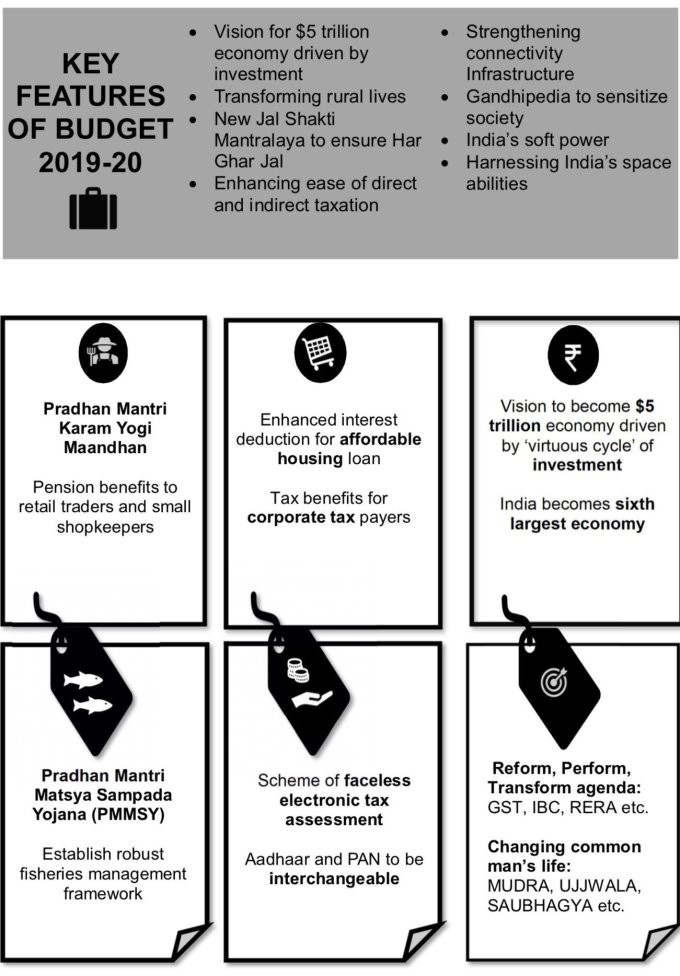
* To make Aadhaar, PAN interchangeable to file tax returns

* Tax proposals aim to stimulate growth, housing

* Direct tax mop up 11.37 trln rupees FY19 vs 6.38 trln FY14
* Seeing double-digit growth in direct tax revenue annually

* Corporate tax now 25% for cos with 4 bln rupees/yr revenue

* Corporate tax cut to cover 99.3% of all cos

INDIRECT TAX

* To raise road, infra cess on petrol, diesel by 1 rupee/ltr

* To up special additional excise on diesel by 1 rupee/ltr

* To up special additional excise on petrol by 1 rupee/ltr

* Proposing certain amendments to Customs Act

* Raising customs duty on precious metals to 12.5%

* Raising customs duty on gold

* Customs duty being exempted on some parts of e-vehicles

* 5% customs duty being imposed on imported books

* To implement fully-automated GST refund module

* GST led to lower rates on almost all commodities

* Tax deduction of 150,000 rupees on e-vehicle loan interest

* Extra 150,000-rupee tax deduction on some small home loans

* RBI, banks to absorb merchant discount rate at small shops

* No merchant discount rate on e-transaction at small shops

10 POINTS OF VISION

* Building social infrastructure among 10 points of vision

* Building pollution-free environment among 10 points of vision

* Digital India in every sector among 10 points of vision

* Make in India with stress on MSME in 10 points of vision

* Water management, clean rivers among 10 points of vision

* Export of food grain in 10 points of vision

* Ayushman Bharat, clean India among 10 points of vision

* Space programmes, safety of citizen in 10 points of vision

GROWTH, INFLATION
* Well within capacity to reach $5-trln economy in few years

* India to become $3-trln economy in FY20

* India now 6th largest economy vs 11th five years ago

REFORMS
* Need to continue undertaking structural reforms

* Need to continue structural reforms to reach $5-trln aim

* Need to invest in job creation in MSMEs

* Need to invest heavily in digital India, job creation

* $5-trln economy target is imminently achievable

* “Gone are the days of policy paralysis”

* Wish to propose many initiatives to kick-start growth

* Reforms needed in power tariffs

* To soon announce policy package for power tariffs

* Model tenancy law to soon be finalised

* Propose several reform measures for rental housing

* PPP to fast develop track, rolling stock, freight svcs

* To have blueprint for water grids, gas grids, airways

* Examining performance of UDAY scheme

* One nation, one grid to ensure power connectivity

* 2 more terminals at Sahibganj, Haldia to be functional soon

* Movement of cargo in river Ganga to rise 4 times in 4 yrs

FINANCIAL SECTOR, MARKETS

* STT to be limited to gap between settlement, strike price

* Propose some leeway in Securities Transactions Tax

* Propose to implement steps to make tax compliance easier

* Bad loan tax norms for most NBFCs at par with banks

* Need for greater parity in tax treatment of NBFCs vs banks

* CBDT to make provisions for pending assessment of startups

* Start-ups not to face scrutiny in terms of share premium

* Taking steps to resolve angel tax issue for startups

* To start scheme for foreign cos in advanced technology sector

* To start scheme to invite foreign cos in sunrise sectors

To give PSU banks 700 bln rupees capital

* Banks’ NPAs reduced by more than 1 trln rupees last year

* Domestic credit growth risen to 13.8%

* To let all NBFC to participate in trade receivable platform

* Propose to return regulation over housing fin cos to RBI

* Propose more power to RBI over NBFCs in Finance Bill

* One-time, six-month guarantee to PSU banks to buy some NBFC loans

* Fundamentally sound NBFCs should get funding from banks, MFs

* To undertake steps to improve governance in PSU banks

* Provision coverage ratio of banks highest in 7 years

* Six PSU banks enabled to come out of prompt corrective action

* To start raising part of borrowing from external market in FX

* To boost retail participation in CPSE ETFs

* India’s sovereign external debt to GDP ratio less than 5%

* To offer ETF participation via ELSS-like system

* Setting divestment target of 1.05 trln rupees for FY20

* Govt to reinitiate process of Air India divestment

* Onshore insurers’ net owned funds need cut to 10 bln rupees

* Strategic divestment of PSUs to remain a priority

* Mulling below 51% stake in PSUs on case-to-case basis

* To raise cap on foreign shareholding in some PSUs

* Steps to separate NPS Trust from PFRDA

* Financial gains from cleaning banking sector now visible

* FDI inflows remain robust despite global headwinds

* Important to increase retail invest in T-bills

* Propose to create platform for listing social enterprises

* To work with regulators for AA bonds as collateral for repo

* Asked SEBI to mull hiking minimum public shareholding to 35%

* Propose to rationalise existing KYC norms for FPIs

* India needs 20-trln-rupee estimated investment every year

* To put in place action plan to deepen long-term bond mkt

* Action plan to deepen market for long-term bonds

* Invest driven growth requires access to low-cost capital

* To create payment platform for MSMEs

* Large infrastructure can be built on land owned by CPSEs

* To allow FPIs to subscribe to listed debt papers of REITs

* Propose to merge NRI, FPI investment scheme routes

* To mull hiking FDI limit in media, insurance, animation cos

* Contemplating an annual global investors meet in India

* Propose 100% FDI in insurance intermediaries

* To examine suggestions to further open up FDI in aviation

* FDI flows rose 6% to $64.37 bln in FY19

* Propose to make India a more attractive FDI destination

* To take steps for RBI, SEBI depositories’ inter-operability

* To allow FPIs to subscribe to listed debt papers of REITs

* Propose to merge NRI, FPI investment scheme routes

* To mull hiking FDI limit in media, insurance, animation cos

* Contemplating an annual global investors meet in India

* Propose 100% FDI in insurance intermediaries

* To examine suggestions to further open up FDI in aviation

* FDI flows rose 6% to $64.37 bln in FY19

* Propose to make India a more attractive FDI destination

* To take steps for RBI, SEBI depositories’ inter-operability

* To allow FPI invest in listed debt securities of InvITs

* Will take steps to meet 25% public holding in listed PSUs

* Need to encourage continued growth of startups

INFRASTRUCTURE, INDUSTRY

* To invest 100 trln rupees in infrastructure over next 5 years

* To set up panel on long-term funding for infrastructure

Need to invest heavily in infrastructure

* Rail infra may need investment of 50 trln rupees 2018-2030

* 2nd stage of Bharatmala to help develop state roads

* To incentivise advanced vehicle battery manufacturing

* Need to develop inland waterways for cargo movement

* To comprehensively restructure national highway programme

* To comprehensively restructure national highway programme

* 210 km of new metro lines operationalised in 2019

* Launching national common mobility card

* To leverage engineering skill for project maintenance work

* Public infra, affordable housing to be taken up in FY20

* To aid cluster-based development of traditional industries

* To use more PPP mode for metro rail network

* Railways to be encouraged to use SPVs for suburban projects

* To use USOF, PPP mode for speeding up BharatNet

* To deal with tax issues of start-ups later in speech

* To start TV programme exclusively for startups

FARM SECTOR
* Every rural family to have gas, power connectivity by 2022

* All rural families to have electricity connection by 2022

* Govt keeps Antyodaya at core of all its policies

* Villages, poor, farmers at centre of every govt plan

* Gaon, garib, kisan at centre of every govt plan

* To invest widely in agriculture infrastructure

* Bamboo, khadi, honey to be focus for cluster development

* To invest 802.5 bln rupees to upgrade rural roads in 5 years

* To upgrade 125,000 km of rural roads in 5 years

* 30,000 km roads under PM Sadak Yojana built with green technology

* All-weather roads provided to 97% of habitation

* To have robust framework for fisheries mgmt network

* 19.5 mln homes to be given till 2022 in PM rural house plan

* 15 mln homes completed under PM rural house plan

* APMCs shouldn’t hamper farmers from getting fair price

* Zero-budget farming to be promoted

* Hope to form 10,000 farmer producer organisations

* Aiming oilseed self sufficiency, to help cut import bill

* Ease of doing business, living should apply to farmers too

* To create infrastructure for cattle feed manufacturing

* Will support private companies to add value for farm producers

* Zero-budget farming can help double farmers’ income

SOCIAL SECTOR, EDUCATION

* See rapid urbanisation as an opportunity, not challenge

* Constructed 96 mln toilets since Oct 2, 2014

* To expand Swachh Bharat plan to undertake solid waste mgmt

* India to be open-defecation-free by Oct 2

* Over 95% cities have become open-defecation free

Identified 1,592 blocks for Jal Shakti Abhiyan

* To use CAMPA funds for Jal Shakti plan

* Aim water connection to every household by 2024

* To set up national research foundation to assimilate all grants

* To bring new national education policy

* Will bring in new national educational policy

* 3 mln workers joined govt pension plan so far

* Banks to provide assistance under Stand-Up India scheme

* Stand-Up India scheme to continue till 2025

* Expect less labour disputes as laws get streamlined

* Propose to develop 17 iconic tourism sites

* Propose digital repository for tribal heritage

* Propose to revamp India Development Assistance Scheme

* Opened 5 new embassies in Africa FY19, to open 4 more

* Propose to launch mission to integrate traditional artisans

MISCELLANEOUS

* Election 2019 mandate was full of hope for new India

* Voters stamped their approval on a performing government

* People of India voted for national security, economic growth

* Have set the ball rolling for new India

* Govt provided fiscal discipline during 2014-2019

* Average food security amount almost doubled during 2014-19

* Our last-mile delivery stood out, reached everywhere

* Will further simplify procedure, reduce red tape

* Mega programmes initiated in 1st term will continue

* We don’t look down upon legitimate profit-earning

* To take step for virtuous cycle of domestic, foreign investment

* Time right for India to enter aircraft financing, leasing

* Launched co to tap ISRO’s capabilities commercially